“It’s about Time” In this piece, I weave together the classic nude figure with one the today’s gadgets that some people can’t part with. I wanted a timepiece that would also represent a stopwatch. I chose a TAG watch because at the time of conception, it was considered a quality watch made with classic craftsmanship the way I feel about the Academic painting. An i-watch, needs charging and the TAG is self-winding by the body’s movements. Capturing a moment in time with the watch hands still on the TAG as the runner’s hands are before the start of the race. You see it’s all about time, the moment at start of our life when we are young, strong, ready and willing to rise to the challenge of life. Not the end of our lives where our bodies are tired and some will have won and some will have lost. Some will have found a way to finish and some will broken-down along the way. Others will have the victory stolen from them, or life will just have gotten in the way. It’s about having the opportunity to start the race and be equal on the line with one another. The perspiration on the runner is subject to interpretation, it could be anxiety to make a move to soon or fear of not rising up to the occasion in time. I feel it’s the warmed up persona that is well tuned and ready to tackle the task that is before him. I painted the runner to be fit and trim and well prepared for this race. The body is our temple and talking care of it is part of life’s challenge so that we a fit to finish strong. So rise up to this task of running in this life we call the human race “It’s about time”. In the end when the body stops moving the TAG will also stop for both are intertwined. This painting is painted in the Academic style with a green/gray under painting, and all the colors are glazed over the under painting. This method gives the viewer the illusion of being in front row of the race. You will not be able to see the full illusion of this unless you are standing in front of the painting because the camera flattens the image. The camera sees with one lens (monocular) and we see with two lenses (binocular) so we can see depth. The light travels through the glazes and down to the under painting and refracting back to us with the information or illusion of depth.
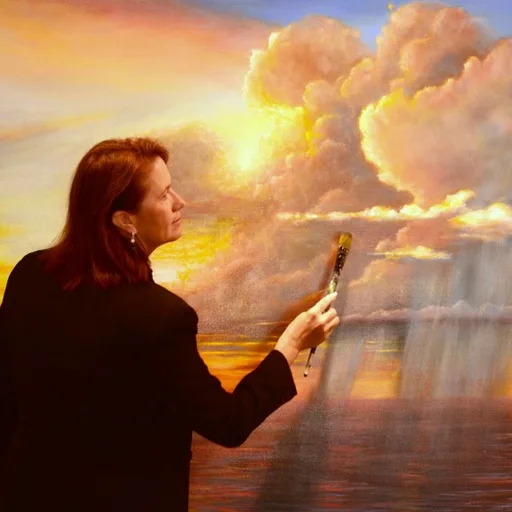
Bio - Julie Griffin I have always known that I was to be an artist. When I was young, I would draw sketches and sell them to my neighbors for a few cents. My neighbors enjoyed a good laugh, but encouraged me to keep at it. I loved art classes and an after-high-school (FMHS) painting class with Myrtle Persons. This settled it for me. I was to be an artist. I attended FSU in 1985 and earned a BFA in Fine Arts with a minor in Art History and Art Education. Sadly, I did not learn what I went to learn and searched for 15 years until 1999 when I found Frank Covino and his Academic way of teaching art. I studied with him for twenty years while I raised my children and finally I feel I have a good foundation in which to draw from. Drawing images has always come easy to me. I find it flows faster and better with each passing day. I don’t know where the gift comes from, but I do consider it a gift. I consider myself a realist painter or better defined as an Academic artist. What is Academic Art? It is defined as the method of painting a three-dimensional object by creating an illusion on a two-dimensional surface. I do this to train my eye and unlock methods that the masters used to paint their masterpieces. Only by studying the masters can we learn from them, their methods and techniques, as they are not often taught anymore. So, I attempt to match the artist using the rules and try to figure out what rules he changed. Think of it from a musical standpoint. A piano student would first learn the notes and how to read music. Then, when ready, he would learn to play as the masters did in order to improve his own skills. If you didn’t have the knowledge of the keys, notes and tones, then it would be impossible to compose music. When ready, the musician would be able to compose his own music and could pull from all the masters he studied to form his own composition with his own visions and translate this to paper. Academic painters are only permitted in the Louvre and must apply with samples of their work in order to be permitted to paint there. I enjoyed the challenge of painting in the Louvre twice and The National Gallery of Art in Washington DC, and the honor that came with the experience. My art shows the depth and true colors of the original when they are meant to be an exact replica/copy. When I do a study of a painting, I may make changes to the original to make it an even better work of art. After all, painters are human and can and do make mistakes. If I repainted them, the viewer could say I made the mistake, so I fix them in my replicas. For the last 20 years I have honed this process for the purpose of improving my own works. This enables me to apply what I have learned to my own works of art. I teach and continue to take classes because I believe we never stop learning and must continue to practice our craft to stay sharp. I enjoy passing along the knowledge I have learned. I know how precious the information is for aspiring artists.