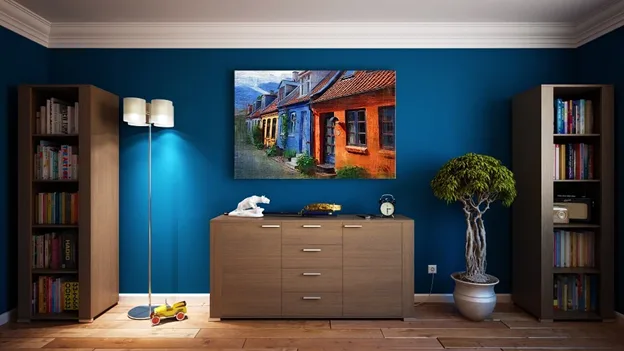
Colour schemes, focal points, depth and care: nine ideas for working art into an interior design project.
Artblr··4 min read·
In short
Art can guide a room's design: a favourite piece helps set the colour scheme, paper templates let you test placement, and one key work becomes the focal point and finishing touch. Mix mediums for depth, favour originals and keep art away from sun and humidity.
Almost everyone takes good care of their homes and designs them accordingly to create rooms that make us feel better and calm. Interiors can be customized in several ways depending on the desired outcome. One way to make our living space reflect artistry and style is by buying artworks and incorporating them thoughtfully on the walls. The importance of decorating walls with artwork is undervalued. It's the last thing on the list to be dealt with while decorating a room or any space. Art has the potential to change a space and enrich it with passion when chosen carefully.
Artwork can be a perfect decorative item for your walls in almost any design. Customizing room space or adding artwork on walls requires a tiny amount of research and effort. Also, there are plenty of interior design catalogues available on the internet that provide a whole bunch of creative ideas. Some of them are mentioned below.
Select a Colour Scheme
Artwork can highlight your history, introduce vital aspects, or be the ideal component for your desired layout. In interior designing, one of the most challenging decisions is to select a colour scheme for your space. Therefore, the smartest move would be to start by examining the colours in a piece of art. Once you have invested in a painting or artwork you adore, you may utilize it to assist you in determining a colour scheme for your space.
Try it on to view how it fits
Suppose you are concerned about placing artwork on the wall while customizing your room. In that case, the best idea is to cut pieces of chart paper in the dimensions of your frames for a gallery wall and test out a few different spots to make sure you are selecting the correct position. Even if you change your mind, there is no need to worry about it as a nail hole is relatively small and quickly spackled.
Art as Centre of Attention
Artwork is a significant component of current interior design trends. Invest in the Art that complements the rest of your space and conveys a story to you. Every room requires an object that draws everyone's attention in a couple of seconds. Thus, using Art as a centre of attention is generally a great idea. Whatever artwork you purchase, be sure to place and accentuate it properly so that everybody who enters your home gets stunned by your sense of style and taste.
Provides Final Touch to the Area
After you finish furnishing your space and your walls are painted with the desired colour scheme, hang the wall art in the decided position. The artwork gives a final touch to your room and brings it together so that it looks complete. It is that little extra element that can transform your room from basic and uninspiring to carefully designed. Therefore, don't be scared to inject some colour and imagination into your space.
Unique Art Piece
While purchasing art replicas might be inexpensive and convenient, there is nothing quite like being the only legal owner of an original artwork that can be passed down for generations. Nothing beats the sense of owning a painting that an actual artist creates over many hours. That being said, you don't want to waste your money, time, or effort on an art piece that was offered to you as an original but isn't.
Adds a Sense of Depth
Artworks are created in different dimensions and sizes. Thus it helps to acquire wall art in various mediums to give the room a more diverse sense of depth. In addition to paintings, you could also buy shadow boxes or sculptures to add more texture to the room.
Anything may be considered Art
There is no official council sitting around a round table deciding what is Art and what is not when it comes to your own house. Hang a postcard, your first movie tickets with your loved one, a conceptual poster, and you have got yourself some wall art.
Experiment with combinations
There is no such thing as terrible ideas, only awful implementation. Think twice before adding something in the mix that you don't think will make sense. Even if it is not perfect Art, it may take on a new meaning when combined with various art pieces or furniture. Therefore, try different position pairings and locations.
Gentle Handling
Besides direct sun exposure, humidity is another aspect that might ruin the quality of the artwork. Therefore, you should pick a location with minimal humidity and no direct contact with sunlight or water. Also, moisture can cause damage, so simply dusting your painting from time to time is enough to clean it.
Frequently asked questions
How do I choose a colour scheme around a piece of art?
Start by examining the colours in a piece of art you love. Once you have invested in it, use its palette to help determine the colour scheme for the rest of the room.
How can I test where to hang art before drilling?
Cut pieces of chart paper to the sizes of your frames and try them in a few spots on the wall. If you change your mind later, a nail hole is small and quickly spackled.
Should I buy original art or reproductions?
Reproductions are cheaper and convenient, but an original can be passed down for generations. Make sure a work sold to you as an original really is one.
How do I add depth to a room with art?
Choose wall art in various sizes and mediums, and add shadow boxes or sculptures alongside paintings to bring more texture to the room.
How do I protect artwork at home?
Place it somewhere with low humidity, away from direct sunlight and water. Occasional dusting is enough to clean a painting.
 Buying artWhy invest in art? Financial benefits and opportunities to discoverA tangible asset, a way to diversify and an everyday pleasure: why art appeals to passionate collectors and savvy investors alike.November 15, 2024
 Buying artArt as a Unique Gift: Why Giving a Work of Art is an Original IdeaLooking for a gift out of the ordinary? A work of art is unique, personal and lasting, and it supports an artist. Seven reasons to give art.October 2, 2024
 Buying art5 Artistic Portraits Perfect For A Freestanding DisplayDigital art, NFTs, themed series, photography and interactive portraits: five kinds of portraits that come alive on a freestanding display.