Arab Revolution
Huile · 2013 607 vues
Fait par un humain
O. Yemi Tubi certifie avoir créé cette œuvre à la main, sans image générée par intelligence artificielle.
This painting was inspired by the Arab spring started in late 2010. I empathise with people that live under the tyrannical leaders like Ex-President of Tunisia, Zine el-Abidine Ben Ali and Late Muamaar Gadaffi. Reading about the tragic death of a Tunisian man, Mohammed Bouazizi that set himself on fire; his response to daily humiliation by the Tunisian authorities, which encapsulates the true spirit of the Arab revolts. Suffering and killing of people that were demonstrating for their freedom moved me to do this painting in honour of those that were killed. The main image in the painting is to represent the portrait of an Arab tyrannical Leader. Start from the head scarf; the red patterns of the scarf are the blood’s drops of those killed in the revolution. The face of the portrait is fist of victory in the face of the tyrannical Arab Leader. The time on the wrist watch on the painting is to indicate that time is running out for all the tyrannical leaders of the world. Many of the revolutions were often involve mainly men especially in the Arab world. During the Arab Revolution, women stood beside their men to fight for their freedom. Just as in the famous French Revolution’s painting by Eugène Delacroix – 1830 – Liberty Leading the People, The woman in middle of the painting leading the Arab Revolution with hand raised high clenching a Blackberry mobile phone. The most powerful weapons for this Arab revolution were mobile phones which hence called the Blackberry revolution. Many images of atrocities committed by these tyrannical leaders and their governments were recorded and passed around through msn, twitter and Facebook by eye witness from mobile phones. At the background of the painting are the explosions on both sides of the painting which are painted the shape of raised clenched fist and on the left bottom corner of the painting lies the former tyrannical Libya leader- Muamar Gadaffi and two other bodies of his men in front of the tunnels where they were captured before they were killed. The ultimate goal of Arab revolution is PEACE and JUSTICE. People that had enough of violence and abuse from their tyrannical leaders rose up in PEACEFUL Demonstration to call for change. It is a shame that the PEACE that Arab people yearned for still eluded them with wars still going on in Iraq, Libya, Syria and Yemen.
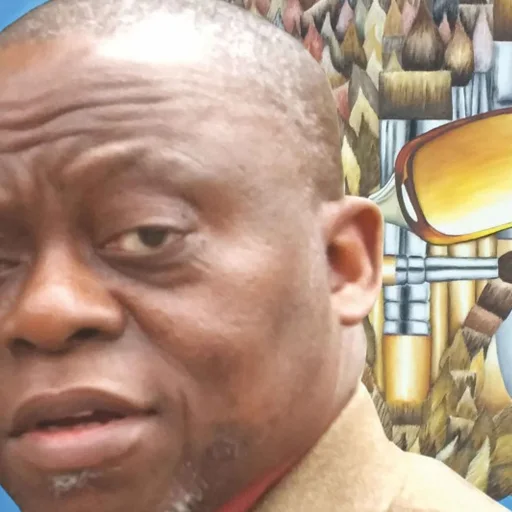
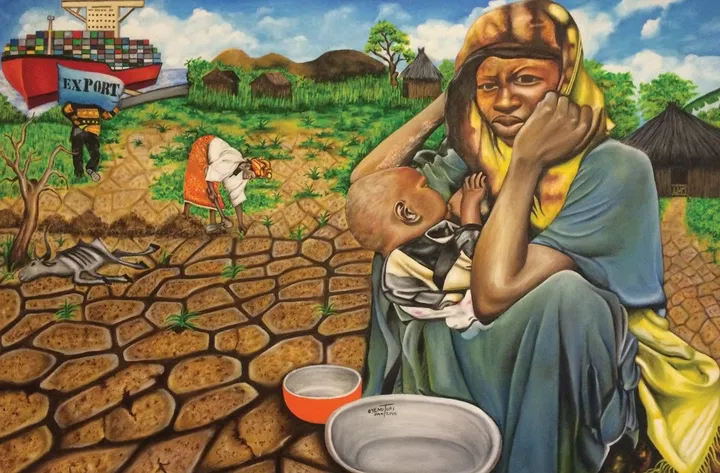
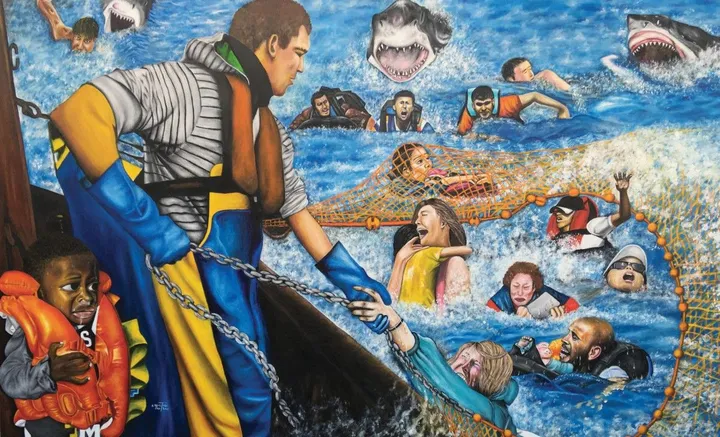
Like some of the old art masters Delacroix and Goya that spoke about social and political upheavals of their time in their works, O. Yemi uses some of his paintings to express himself about on-going political and social issues around the world. “A work of art which did not begin in emotion is not art” so said Paul Cezanne; O. Yemi was deeply moved by the horrors of wars and the plight of immigrants drowning in the sea to pick up his brushes again. His first political painting was “ARAB REVOLUTION” influenced by Arab Spring that started in 2012. “THE EAGLE HAS LANDED” was done to speak about American led war on terror. His painting -“KABIYESI OBA OBAMA (Unquestionable King Obama)” was a political satire based on the love and hate relationship between President Obama and Donald Trump. “THE BLEEDING ROSE” was done in solidarity with Christians beheaded by ISIS in Iraq and Syria. “Hunger in the Land of Plenty” and “OIL: AFRICANS’ WEALTH and WOE” were about poverty and exploitation of African people. He also used his painting – “UKRINE: THE UNFORTUNATE BRIDE” to speak about how America and Russia influenced the war in Ukraine. “THE FISHERS OF MEN” was about immigrants drowning in the sea. When O. Yemi works on portrait paintings, he desires his portrait paintings to be uniquely creative. He often uses the paintings to tell stories about his subjects. In one of his commissioned paintings “Josanne of Trinidad”, he blended the images of the parents at the top background cloud and the main subject below the images of her parents. This is to indicate that the parents are in heaven looking down on Josanne. He often uses his subjects’ professions to create their paintings. He used artist materials to create his painting “PORTRAIT OF AN ARTIST” and image of violin for the portrait of “THE VIOLINIST” He used books and flowing letters to create the portrait of Professor Wole Soyinka, 1986 Nobel Prize Winner in Literature in painting “SOYINKA: AN AFRICAN LITERARY ICON” O. Yemi has widely exhibited his works around the world in group and solo exhibitions. His works had featured in exhibitions in Bogota, Colombia; Vancouver, Canada; UN exhibition, Milan, Italy; Tokyo, Japan; USA and in many cities across the United Kingdom. O. Yemi has received many awards for his works across the world; his works have also been published in many art magazines and contemporary arts books. He is a member of the Fine Art America, the Society of All Artists, AERA –the Association Embracing Realistic Art and WCA- World Citizen Artists. O. Yemi paintings and awards can be seen on his website: www.o-yemi-tubi.pixels.com