African't (Africans can't say no to Exploitation
Huile · 2016 545 vues
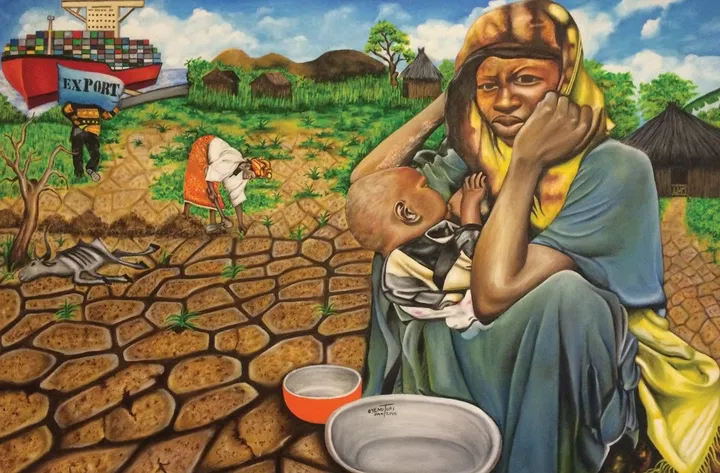
Africa is the second largest continent and the richest in the world in natural resources. Despite her riches, her people are the most abused and misused people in the world. They were the subject of slavery and after the abolition of slave trade, Europeans continued to enslave Africans. They colonised most of the continent, oppressing and killing Africans while looting their natural wealth. African nations are yet to be completely free; their economy and government are being controlled by their former colonial masters. In recent years, China joined the United States and the Europeans in further exploitation of Africans. Chinese are now taking over African businesses and markets; flooding African markets with their cheap products making it difficult for locally produced African products to compete with cheap Chinese imports. Many corrupt African leaders aid wanton exploitation of African mineral resources for selfish personal gains, receiving also kickbacks to award highly over-priced infrastructure development project contracts to Chinese and European companies. Chinese companies often bring in all categories of workers from China to work on African construction projects while well qualified Africans including overseas trained professionals remain unemployed; it is literally taking food out of the mouth of Africans. Why can’t African say `no’ to exploitation? The dark cloud in the background on the right side of this painting is to show the terrible situation of African nations; the ray of light breaking through the dark cloud and new plant shoots piercing through the cracks of dry ground are to depict the hope and aspiration of the artist - O Yemi Tubi for African nations - better and richer future. In the centre of the painting, O Yemi painted a starving African child with priceless jewellery on her neck and variety of foods served on luxurious golden bowls and plates in front of her. This also is to depict the paradoxical poverty and the riches of the continent of Africa. Engulfing the luxurious varieties of food are rats in coats of national flags of USA, Britain, France and China. This is to say that the relationship of these nations with African nations is contributing to their poverty. Rat as imagery of these nations is not intended to offend but O. Yemi couldn’t find any complementary image that could be used without losing the message he intended to convey. This painting is also an Indictment of some corrupt African leaders The dawn of new day; better and bright day for Africans will come the sooner the Africans can say `no’ to EXPLOITATIONS and African leaders put national interest above self-interest.
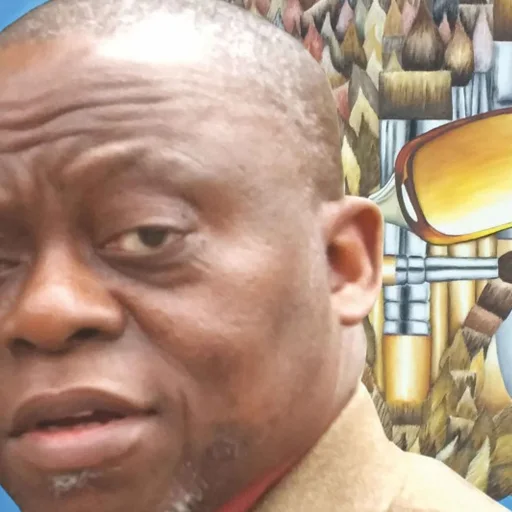
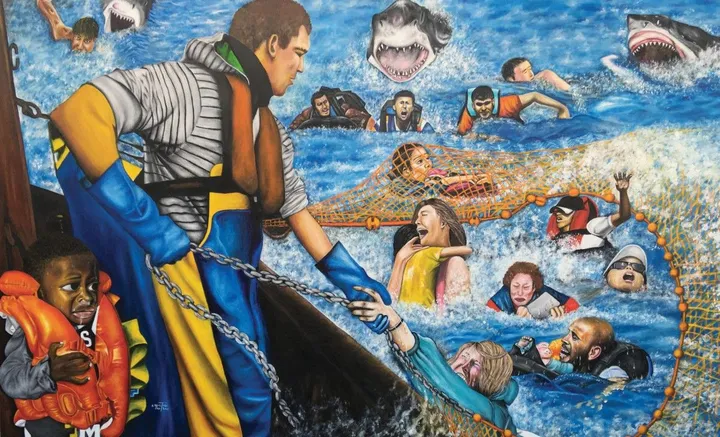
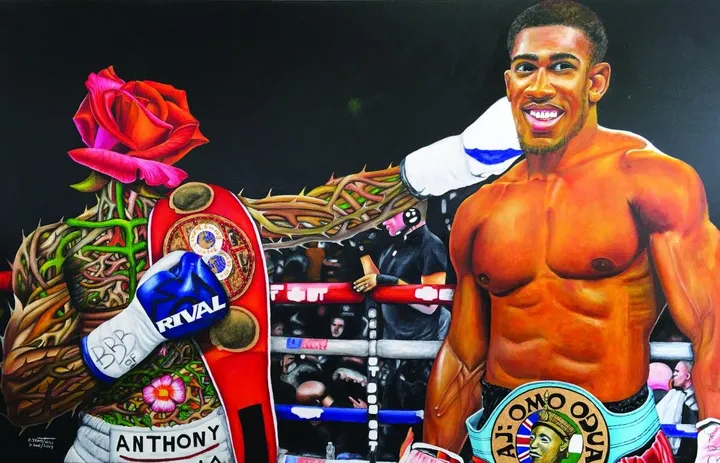
Like some of the old art masters Delacroix and Goya that spoke about social and political upheavals of their time in their works, O. Yemi uses some of his paintings to express himself about on-going political and social issues around the world. “A work of art which did not begin in emotion is not art” so said Paul Cezanne; O. Yemi was deeply moved by the horrors of wars and the plight of immigrants drowning in the sea to pick up his brushes again. His first political painting was “ARAB REVOLUTION” influenced by Arab Spring that started in 2012. “THE EAGLE HAS LANDED” was done to speak about American led war on terror. His painting -“KABIYESI OBA OBAMA (Unquestionable King Obama)” was a political satire based on the love and hate relationship between President Obama and Donald Trump. “THE BLEEDING ROSE” was done in solidarity with Christians beheaded by ISIS in Iraq and Syria. “Hunger in the Land of Plenty” and “OIL: AFRICANS’ WEALTH and WOE” were about poverty and exploitation of African people. He also used his painting – “UKRINE: THE UNFORTUNATE BRIDE” to speak about how America and Russia influenced the war in Ukraine. “THE FISHERS OF MEN” was about immigrants drowning in the sea. When O. Yemi works on portrait paintings, he desires his portrait paintings to be uniquely creative. He often uses the paintings to tell stories about his subjects. In one of his commissioned paintings “Josanne of Trinidad”, he blended the images of the parents at the top background cloud and the main subject below the images of her parents. This is to indicate that the parents are in heaven looking down on Josanne. He often uses his subjects’ professions to create their paintings. He used artist materials to create his painting “PORTRAIT OF AN ARTIST” and image of violin for the portrait of “THE VIOLINIST” He used books and flowing letters to create the portrait of Professor Wole Soyinka, 1986 Nobel Prize Winner in Literature in painting “SOYINKA: AN AFRICAN LITERARY ICON” O. Yemi has widely exhibited his works around the world in group and solo exhibitions. His works had featured in exhibitions in Bogota, Colombia; Vancouver, Canada; UN exhibition, Milan, Italy; Tokyo, Japan; USA and in many cities across the United Kingdom. O. Yemi has received many awards for his works across the world; his works have also been published in many art magazines and contemporary arts books. He is a member of the Fine Art America, the Society of All Artists, AERA –the Association Embracing Realistic Art and WCA- World Citizen Artists. O. Yemi paintings and awards can be seen on his website: www.o-yemi-tubi.pixels.com