The Politician
2015 460 vues
- 0 % de commissionEntendez-vous directement avec l'artiste : tout le prix lui revient.
- Réponse en 48 hOn relance les artistes qui ne répondent pas. Les messages sont traduits automatiquement.
Caractéristiques
- Catégorie
- Techniques mixtes
- Dimensions
- 91,4 × 71,1 cm
- Année
- 2015
- Édition
- Pièce unique
- Encadrée
- Non
- Signée
- Oui
During election, the people aspiring for certain positions come to our doorsteps, in fine clothes, doing their campaigns, telling us to vote for them. The promise water, food, good roads, free education, free healthcare, employment. But beneath the nice clothes are holes. They are the shortcomings and fake promises. These leaders are not always good people, and the promises they make are not always what they are in the job for. But we can’t see them at first because they cover them with expensive clothes and sweet promises. It is only after we elect them that we see the holes. Those un-kept promises. No education, no water, roads, healthcare. We still see poverty, inadequate power supply, unemployment. Holes. After we elect them, the truth about them comes out. We realise that all they wanted was our votes so they could be in power, so they could embezzle money. We realise all they want is for themselves, not for us. That is the politician. This is a daily reality in Nigeria, and it is frustrating. Now the left side, that is what politicians are supposed to do. They are supposed to defend us, fight crime, protect the nation. They are supposed to help us realize our dreams by giving us at least just the basics – water, food, roads, healthcare, power supply, employment. We need good leaders.
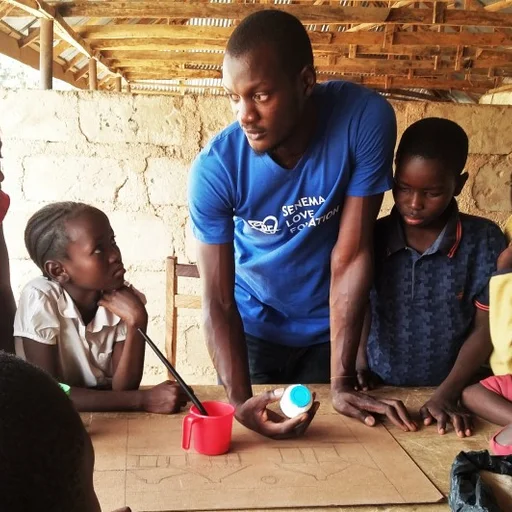
Many peacebuilding and development professionals work from their offices for governments or NGOs. Emerging artist Luka Chohu (also known as Lucho) works out of his own small compound in the community of Angwan Juma’a, Jos, Nigeria. This is a place where people “hustle” from morning till night to provide for their families – a place where art is generally not encouraged as a viable career path. To be sure, this artist does his fair share of hustling. But in between, he finds time to stretch old sheets over hand-made wooden frames to engage in his own form of peacebuilding and development work. From his small studio, Lucho fuses his artistic talent with his passion for social justice, to communicate the joys and challenges of everyday life in Nigeria; promote peaceful coexistence; and develop the capacities of those around him. His interest in art began in secondary school: “I always had a story to tell. But because I was not good with words or numbers, there was no way for me to tell it.” He therefore began using paint to express his own experiences and feelings. Following secondary school, Lucho moved to the capital to understudy Abuja-based artist, Kelvin Ubani. He then began using his new skills to move his art into broader themes of social justice, inter-identity peacebuilding and the beauty of Nigerian cultures. The purpose of Lucho’s work is twofold. First, using various media, his own art beautifully and honestly presents the paradoxes, joys and challenges of everyday life in Nigeria. It acts as means for himself and others to step back from the daily “hustle,” make sense of what is, and imagine what could be. In the end, what is produced are pieces with both aesthetic value and the ability to communicate such realities to both local and international audiences. Second, Lucho dreams of also using his talent to increase the creative and communicative capacities of others, particularly children in Jos who cannot access proper education, either because of displacement or poverty. Through volunteer work with local NGOs and schools, he has begun gaining experience in this area creating programs for internally displaced and local children learn how to use art to express and value themselves. Truly, Lucho lives as an artist, a development worker, and a peacebuilder.